Tuesday, October 17, 2006

All Business For Beta Court

Surprise, The San Ramon City Council Passed The Crow Canyon Specific Plan As Recommended.

Business owners, San Ramon citizens, planning commissioners, and most of the City Council members came to an agreement for the Crow Canyon Specific Plan and more importantly for the long term direction to have Beta Court continue to provide valuable business services for the San Ramon community without forcing mixed use housing on Beta Court.

The location of the Crow Canyon Specific Plan is as follows:

Approximately 130 acres (over 90 land parcels) bounded by the San Ramon/Danville city limit line to the north, Interstate 680 to the east, Crow Canyon Road to the south, and the San Ramon city limit line to the west.


Many citizen groups and businesses spoke out in fighting to retain these businesses for San Ramon. The threat of eminent domain for any area in San Ramon that is under a Redevelopment Zone is still very real. While City Council members all state that eminent domain would only be used as a last resort, the threat of it still hangs over the head of businesses and property owners.

The City Council talks about market forces driving the redevelopment in this area. The mayor claims that "market forces" will determine how this area is developed. We can only wonder what type of market forces will ultimately affect the landscape in this area.

As passage of this plan was met with a positive outlook for the businesses in the Crow Canyon Specific area, and more specific of the Beta Court business owners, they are still very well aware that the eminent domain issue remains a threat to each and every property owner in the Redevelopment Zones.

Tuesday, September 19, 2006

Eminent Domain Abuses

A Five Year State by State Report Examining the Abuse of Eminent Domain

The following report documents the abuses taking place in America today. It looks at cities just like San Ramon, that ended up using eminent domain to take over properties that were previously off limits to the local governments. There is a new movement affront from the people and also the Federal Government to stop these eminent domain abuses. Contact your Senators and Representatives to make sure the new bill becomes law this year.

Public Power, Private Gain
by Dana Berliner
The Despotic Power

As early as 1795, the U.S. Supreme Court described the power of eminent domain—where the government takes someone’s property for a "public use"—as "the despotic power." Eminent domain has the potential to destroy lives and livelihoods by uprooting people from their homes and businesspeople from their shops. With eminent domain, the government can force a couple in their 80s to move from their home of 50 years. Eminent domain is the power to evict a small family business, even if that means the business will never reopen.

The danger of such an extreme power led the authors of the U.S. Constitution and state constitutions to limit the power of eminent domain in two ways. First, the government had to pay "just compensation." And second, even with just compensation, the government could take property only for "public use." To most people, the meaning of "public use" is fairly obvious—things like highways, bridges, prisons, and courts.

No one—at least no one besides lawyers and bureaucrats—would think "public use" means a casino, condominiums or a private office building. Yet these days, that’s exactly how state and local governments use eminent domain—as part of corporate welfare incentive packages and deals for more politically favored businesses. This is the first report ever to document and quantify the uses and threats of eminent domain for private parties. We have compiled this information from published accounts and court papers covering the five-year period from January 1, 1998 through December 31, 2002. The results are chilling.


Download the entire report at Castle Coalition

Friday, September 08, 2006

Follow The Money

San Ramon Politics, Redevelopment, Eminent Domain, And Money Are In The Mix With The San Ramon City Council


Who Gets The San Ramon Redevelopment Bond Money?

In an article titled: San Ramon redevelopment on the agenda again, by Scott Marshall, reporter with the Contra Costa Times, reports about the issues facing the Beta Court business owners affected by the Crow Canyon Specific Plan, which involves redevelopment of the area surrounding and including Beta Court.

The San Ramon Planning Commission voted 4-1 to remove the housing overlay for Beta Court which in essence would mean that the thriving business owners would in all likely hood remain and continue to provide vital services to the residents. However, the San Ramon City Council could place this new plan with the removal of the housing overlay for Beta Court in jeopardy. In fact, a four-fifths vote is required for passage of the plan.

It has been reported that, "At least one City Councilman, Jim Livingstone, has publicly stated that he did not want the Beta Court Business owners to determine the direction of the Crow Canyon plan."

If the City Council does not approve this plan, then it goes back to the Planning Commission with two newly appointed commissioners that would in all likely hood be reversed and change it to call once again for the housing overlay on Beta Court.

Property owners would most likely be in a position of selling out to developers to reap more profits then would be generated from renting to the business owners. "A consultant's report found that the redevelopment area is 'economically blighted,'" and as such the Redevelopment Agency, which are the same five members of the City Council could use eminent domain to take care of any property owner stragglers refusing to sell out.

To clarify matters, Beta Court is not economically blighted but provides valuable services to the San Ramon citizens. The area is thriving with activity. The business owners have been profitable for years. If the City Council chooses to do what is right for the citizens and business owners of San Ramon then we can look forward to having local service providers for many years to come. If however, the City Council chooses to reject the protection of these valuable service providers, then the City Council will effectively be kicking businesses out of San Ramon.

Maybe it is time to start following the money. By-the-way, speaking of money, the city's Redevelopment Agency is going to be discussing on Tuesday, Sept. 12, before they place their other City Council hats on, in the City Council Meeting: "Whether to set a $59 million bond issue limit."

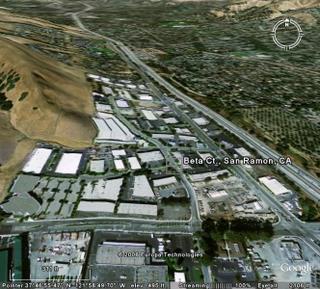
Beta Court, San Ramon, CA

Thursday, April 06, 2006

City Council Attempts To Justify Eminent Domain

San Ramon City Council

The San Ramon City Council meeting and the Redevelopment Agency meeting held on March 28, 2006 was filled with speeches from the City Attorney, Byron Athan and members of the San Ramon City Council, Mayor H. Abram Wilson and Councilmember David E. Hudson.

The City Attorney, Byron Athan gave a speech about how Eminent Domain has been around since the beginning of our country. The use of eminent domain was limited to public works projects such as roads, canals, and dams. Under the Eminent Domain passed in the redevelopment Agency amendment however, it allows for a much more encompassing use of eminent domain. As time has gone on, Eminent Domain has been used by other cities to do all sorts of things. See: Kelo v. New London. The attorney mentioned that one city had even used Eminent Domain to take over a "Private Golf Course." The attorney said he could not see this council using the eminent domain tool that way in the foreseeable future but felt it would be a good tool to have as, in his analogy, that being a "life-preserver."

Mayor H. Abram Wilson got into a tizzy when he accused certain groups of spreading false statements and half-truths concerning eminent domain. He said, "This is San Ramon, This is not Maine, this is not San Jose or San Francisco..."

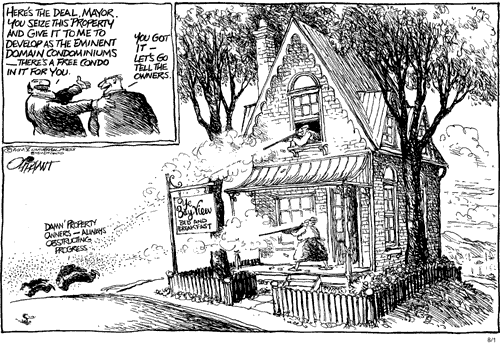
Here's The Deal Mayor


Councilmember David E. Hudson, stated, "Eminent Domain is just another tool in our quiver, we do not intend to use it."

At this point, Mayor Wilson spoke up and said, "Eminent Domain is too expensive for the city to use. We would have to pay everyone's legal fees."

Councilmember Hudson also stated and clarified that this passage of Eminent Domain for the Redevelopment Agency encompasses all areas the Redevelopment Agency has jurisdiction over. He pointed out that there are instances where Redevelopment Agency Eminent Domain might and should be used instead of the Eminent Domain available to the city.

One local property owner spoke out in favor of Eminent Domain, and said he "was not scared of Eminent Domain." This in contrast to all of the other thriving business owners and property owners in the Crow Canyon Specific Plan redevelopment area that spoke out against Eminent Domain at other Redevelopment Agency meetings. This group had a letter read into the records at this March 8, City Council Meeting opposing Eminent Domain.

What Does This Mean For San Ramon?

With the unanimous passage of the San Ramon Redevelopment Agency Amendment, City Council now has at their disposal use of the Eminent Domain Tool. If they never intend to use it, why on earth would they have had to pass it now? There were other options. Council could have passed the amendment without including Eminent Domain. If there was ever a need for Eminent Domain in the future the City Council could have addressed it at that future time.

As Councilman Dave Hudson pointed out, the Eminent Domain Tool now covers a wide area.


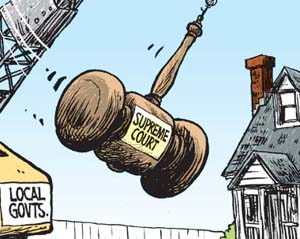
This tool is more like a hammer over the head of all San Ramon businesses and property owners than a life-preserver. At anytime, the Redevelopment Agency can expand their domain. We can only hope that at least two Councilmembers in the future restrict the use of the Eminent Domain tool. That might be a false San Ramon hope... Just look at some of the stories about other cities like San Jose having implemented Eminent Domain and having expanded their use of the Redevelopment Agency, Rezoning, and this tool as time went on.

Other Links And Stories:

Eminent Domain Watch

Monday, April 03, 2006

City Tramples On Constitution

Who Needs The Constitution Or The Bill Of Rights?

Strange, But True

In San Ramon we have The City Council, also known as The Redevelopment Agency. The five Redevelopment Commissioners who also double as the City Council recommended to City Council to pass the Eminent Domain tool at last week's San Ramon Redevelopment Agency Meeting. The Redevelopment Commissioners subsequently placed their City Council hats on their heads and approved the recommendation.

Now, that's the Power to trump the Constitution and The Bill Of Rights.

Friday, March 17, 2006

San Ramon Redevelopment: The Unknown Government

Any Town USA - Is This San Ramon, California?

The Unknown Government


There is an unknown layer of government in California, which few understand.

This unknown government currently consumes 8 percent of all property taxes statewide, $1.5 billion in 1997. It has a total indebtedness of over $41 billion.

It is supported by a powerful Sacramento lobby, backed by an army of lawyers, consultants, bond brokers and land developers.

Unlike new counties, cities and school districts, it can be created without a vote of the citizens affected.

Unlike other levels of government, it can incur bonded indebtedness without voter approval.

Unlike other government entities, it may use the power of eminent domain to benefit private interests.

This unknown government provides no public services. It does not educate our children, maintain our streets, protect us from crime, nor stock our libraries.

It claims to eliminate blight and promote economic development, yet there is no evidence it has done so in the half century since it was created.

Indeed, it has become a rapidly growing drain on California's public resources, amassing enormous power with little public awareness or oversight.

This unknown government is Redevelopment.

It is time Californians knew more about it.

State law allows a city council to create a redevelopment agency to administer one or more "project areas" within its boundaries. An area may be small, or it can encompass the entire city.

These project areas are governed by a redevelopment agency with its own staff and governing board, appointed by the city council.

Thus, an agency and city may appear to be one entity. Often city councils appoint themselves as agency members, with council meetings doubling as redevelopment meetings. Legally, however, a redevelopment agency is an entirely separate government authority, with its own revenue, budget, staff and expanded powers to issue debt and condemn private property.

Out of California's 471 cities, 359 have created redevelopment agencies. No vote of the residents affected was required. No review by the Local Agency Formation Commission (LAFCO) was done.

ANY TOWN USA - IS THIS SAN RAMON, CALIFORNIA?

City Council Member 1: "It would be good if we had a unanimous Eminent Domain consensus among ourselves before we have a public meeting about Eminent Domain."

City Council Member 2: "But, we can not discuss business like that without following the 'Open Meeting' rules under the Brown Act."

City Council Member 3: "That's right, I forgot about that."

City Council Member 4: "But, we are going to get hammered by the public at an Open Meeting."

City Council Member 5: "I know what we can do. We can appoint ourselves to the Redevelopment Agency and discuss the issues privately. That way we will not be in violation of the Brown Act, and can build a unanimous consensus amongst ourselves. That way when the public crys out that they do not want Eminent Domain we can show that we all on the City Council support it completely."

City Mayor: "That's a Great Idea! Make sure you have a good speech set up. We'll tell the public to trust us and that we do not take Eminent Domain lightly. We'll tell them we will use it as a last resort, even though we are targeting a certain court. Heck, we might need to use it on something else also. With all of us supporting it, the public will just have to go along with it."

See the Brown Act, regarding Open Meetings.

Read more at San Ramon Talk

Wednesday, March 15, 2006

Redevelopment: The Unknown Government

Blight Makes Right

Chapter 2

All a city need do to justify creation or expansion of a redevelopment area is to declare it "blighted".

This is easily done. State law is so vague that most anything has been designated as "blight". Parkland, new residential areas, professional baseball stadiums, oil fields, shopping centers, orange groves, open desert and dry riverbeds have all been designated as "blight" for redevelopment purposes.


To make a finding of blight, a consultant is hired to conduct a study. New redevelopment areas are largely driven by city staff, who choose the consultant with the approval of the city council. Consultants know their job is not to determine if there is blight, but to declare blighted whatever community conditions may be.


Read how San Ramon City Council could use their new Dictatorial Eminent Domain powers.

Read more at San Ramon Talk